
One uniform lesson
One lesson, one question set, the same work for everyone.
The story of a system that brings different ages together in one lesson—from the need behind it to its practical use.
01
Imagine one lesson…
In the same classroom there are younger students and older ones.
Some are just beginning; others have been reading for years.
How can all of them benefit from the same lesson at the same time?
Can one lesson work for every level?
Many people assume this kind of lesson must be either too simple or too complicated.
Either the lesson is made lighter so younger children can understand it…
or it is prepared for older students and the younger ones struggle.But what if that assumption is incomplete from the beginning?
02
Education often assumes that a good lesson must be identical for everyone.
Yet for some lessons, the real issue is not being one-size-fits-all…
it is being well differentiated.
Is one uniform lesson always a good lesson?
The system presented on this site overturns exactly that assumption.
One lesson, one question set, the same work for everyone.
The same text, with different work by age and level.
03
The person leading a lesson repeatedly has to ask:
- What will I ask?
- What suits which level?
- What will the younger ones do?
- Will the older ones be bored?
- How will a new student fit in?
This is a major burden not only for the student, but also for the lesson leader.
And the most difficult part is this:
Many Risales are too large to finish in one sitting.
Yet an effective lesson needs questions specific to the part studied that day.
04
That is why a system organised by school range has been prepared:
a Risale-i Nur question bank, question-and-answer sheets, flashcards for memorisation,
and a desktop program that can tailor them to need.
The aim is not simply to give questions.
It is to free the lesson leader from having to prepare from zero for every lesson.
05
The system addresses three core needs at once:
- It makes a lesson easier to lead.
- It gives each student material suited to their level.
- It keeps attention on the Risale being read.
The questions cannot be answered by general knowledge alone.
The student needs to read and reflect on that Risale itself.
06
For example, a question sheet does not give the whole answer.
Only the first few words appear as a clue.
Question sheet
As what benefit, and for which aspect of human life, is the second fruit described?
7 words · Clue: "Life..."Answer key
The complete answer is in front of the lesson leader during checking.
Learning + checkingThis means that even if a student has memorised something, they cannot move on without actually understanding the subject.
The answer key contains the full answer.
So the system supports learning and checking at the same time.
07
A
The main idea is this: questions are prepared specifically for every part of a Risale.
Each Risale is divided into smaller parts.
This makes it possible to prepare a separate question set for one lesson-sized section.
B
But the system is not made up of question sheets alone.
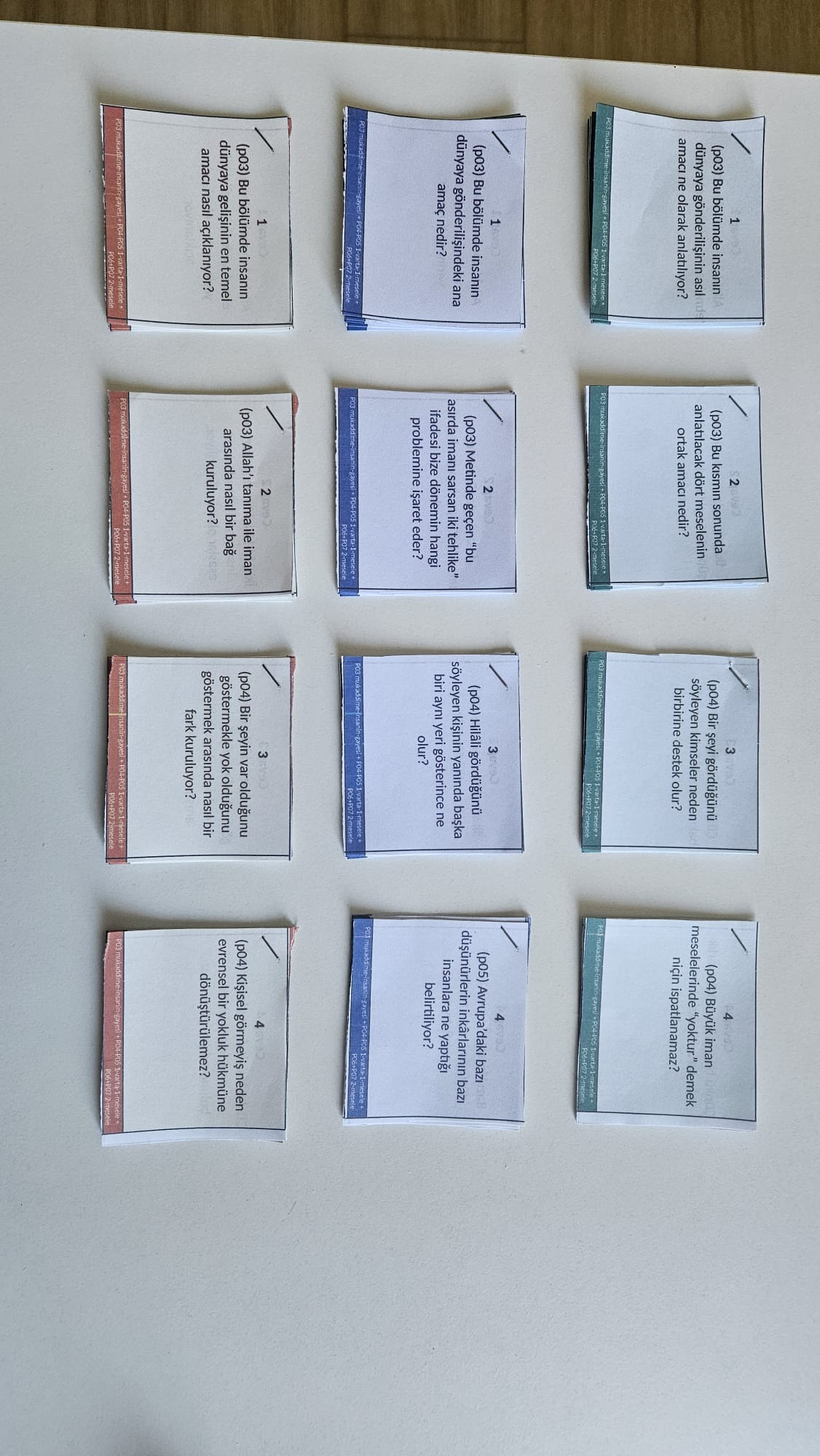
There are also flashcards.They provide another route for the student who wants to memorise.
The student sees the question, tries to recall the answer, and then checks the back of the card.
In this way, the same system makes room for different ways of learning.
08
The recommended use is very practical:
- First, use the flashcards for brief memorisation or preparation.
- Then collect the cards.
- Next, distribute the question sheets and work with the Risale open.
- The lesson leader moves through the room and helps wherever students do not understand.
The lesson becomes not passive listening, but an active process of reading and reflection.
09
What happens when there is more than one student in the same class?
Here is a crucial detail:
there are six genuinely different question sets for the same part.
The questions are not merely rearranged; they are truly different.
6 different sets — real variety
As a result:
- Copying becomes harder.
- The lesson leader can work one-to-one with each student.
- It is clearer how much each student has learned.
10
Perhaps the system's most striking feature is this:
different age groups can progress together in the same lesson setting.There is separate material for younger and older students.
The same Risale can be studied at different levels when needed.This removes the need to choose a text only as simple as the youngest student can understand.
Everyone can remain in the system at their own level.
11
An important part of these materials is prepared with a computer program.
The program makes it possible to:
- Edit file names
- Change page settings
- Choose a colour theme
- See a preview
- Produce the required number of cards
So the system is not fixed.
It can take shape according to the user's needs.
12
There is also an encouragement side.
When a points-and-rewards system is used, a student's motivation can stay alive throughout the term, not only for that day.Most importantly, the reward is not limited to the first three; it is given in proportion to points.
This means students who are weaker do not give up completely.
This web application does not yet include that tracking system; we recommend that you collect and follow the points separately.
13
Finally, the whole system comes together at one point:
questions can be selected from every Risale studied during the term.The student therefore reviews not only one part, but the whole process.
That helps learning become lasting.
Files made up of final questions are in preparation; until then, you can create a final examination by selecting from the questions.
14
The problem at the beginning was:
"How can students of different ages have an effective lesson together?"The answer is:
by building a ready but customisable system…
by dividing the Risale into parts…
by making reflection necessary through question sheets…
by making room for memorisation through flashcards…
and by keeping all this orderly with software support.The point is not simply to prepare questions.
The point is to turn the lesson from a burden into a living learning system.
Prepare.Apply.Follow up.Improve.
Explore the materials